Starting your enrolment is simple. Fill in the form below and our team will be in touch within one business day to walk you through the next steps.

Our enrolment team will reach out within one business day of receiving your enquiry to discuss availability and next steps.

Every family is invited for a tour of the centre before enrolment is confirmed — so you can see the space and meet our educators.

This form is an expression of interest. There's no obligation — we're here to help you find the right fit for your family.
Our enrolment team is warm, knowledgeable and here to help. Complete the form and we’ll be in touch within one business day.

Koalas
6 weeks – 2 yrs
Wombats
2-3 yrs
Possums
3–4 yrs
Roos
4–6 yrs
"*" indicates required fields
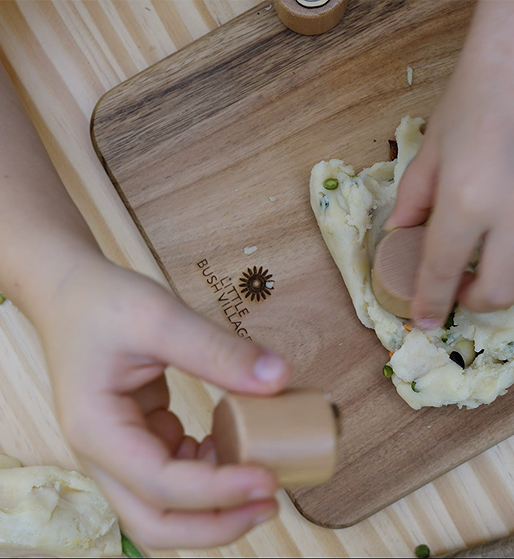
In Australia, nature play is also known as bush kinder (Elliot & Chancellor, 2014). The underlying approach of bush kinder is for children to have unstructured play in natural environments—such as forests, nature trails and beaches—where they can simply be present, engaged in nature and spend time outdoors. Bush kinder is also driven by the belief children have the right to be engaged with nature and open-ended settings allow children to be the driver of their own learning (child-led learning).
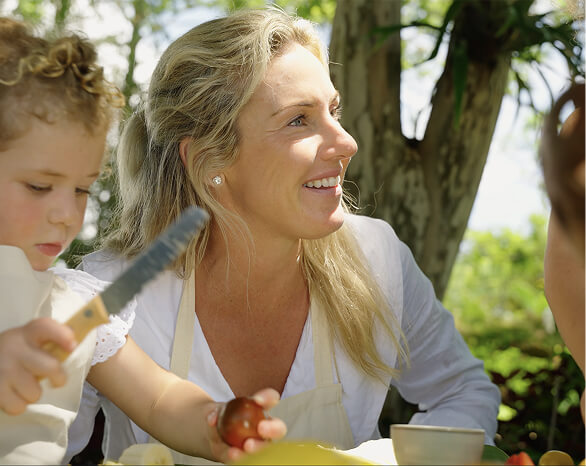
In our nature play program, children learn to assess risk, use and learn about safety precautions and explore, discover and investigate different flora and fauna. This creates deeply imaginative play, forges strong friendships and increases children’s interest in the natural world.
Children’s curiosity is apparent in the questions they pose to our teaching team:


The team found being outside, immersed in nature, helps to initiate such rich questions and investigations for the children.
The benefits of being outside extend from the children to the teaching team and the families. Educators gain a better understanding of children’s skills and interests and can build stronger relationships with them. Families get a better understanding of their child’s capabilities, including risk management, which is essential for engagement with outdoor natural environments.
As children gain more exposure and experience outside, they begin to transfer their past learning to new situations, developing their risk-management skills. In our setting, the teaching team supports children in taking and managing risks. We know children are competent and able to take care of their own safety and the safety of others. This is reflected in some of the things they say when we are out and about:

Don’t touch the mushrooms; we don’t know if they are poisonous or not. Just look at them from here.
I know not to climb on the branches that are smaller than my arms, because it can break and I can fall and hurt myself.

Implementing a successful bush kinder program requires more than just letting children go outside and play. Educators need to constructively plan its underpinning pedagogy and have logistical preparations in place (e.g. weather updates, emergency and evacuation policy and essential items). Risk management, as mentioned earlier, is also an essential element, as the teaching team will need to understand logistical and operational details while adhering to national regulations (State Government of Victoria, 2020).
Our teachers and educators reflect on their role when children are engaging in bush kinder. It’s not just about actively supervising children but also about adopting a ‘co-investigator’ or ‘co-player’ role and guiding children in investigating and discovering the answers to their questions. Teachers and educators also need to assess when to jump in and guide the learning or stand back and allow children to make discoveries for themselves, drive their own learning through real-life interactions and firsthand experiences.
(Figueiredo, 2016)
Children possess an intuitive ability to make their own risk assessments, as they will usually only climb as high as they are comfortable or as high as they are prepared to fall. We need to give them the right tools to make good judgements and they will.
Everything you need to know before taking the first step.
Open everyday, Mon-Friday 7am – 6pm, closed Public Holidays, closed for Easter Friday and Monday, closed from the 24th Dec to the 3rd Jan.
The fees are $160 per day, paid one week in advance via direct debit, credit card or eftpos.
If you are claiming the Child Care Subsidy (CCS) – you will be entitled to 42 days GAP free. https://www.servicesaustralia.gov.au/child-care-subsidy-if-your-child-absent-from-child-care?context=41186
If they aren’t eligible for the CCS, if they give us notice in writing 1 month prior, we can waive their fees for absent periods of up to 10 days consecutively.
Nappies, sunscreen.
1 x fitted sheet, back pack, water bottle, lunchbox with morning tea, lunch and afternoon tea, bottle and formula if needed, hat.
At Little Bush Village we follow guidelines of best practice from Allergy & Anaphylaxis Australia (A&AA), in which they do not promote food bans in schools and Child Education and Care (CEC) services. Instead, A&AA promotes an Allergy Aware approach as recommended in the Best Practice Guidelines for preventing and managing anaphylaxis in schools and CEC services.
What is Allergy Aware?
Allergy Aware means having many things in place to reduce the risk of an allergic reaction and to recognise and treat an allergic reaction well when it occurs.
Ways for schools and CEC services to be Allergy Aware:
Know who is at risk of anaphylaxis and what they are allergic to
Why not food bans?
Allergies which can cause anaphylaxis can develop to any food including staple foods like cow’s milk, wheat, and eggs. Staple foods are in most lunch boxes and in many canteen menu items so are difficult to ban. Some people are allergic to many foods.
If one type of food is banned, it sends a message that that some food allergy is more serious than other food allergy which is not true. Banning one type of food does not help protect students with allergies to other foods.
Other reasons why A&AA doesn’t promote food bans:
We gather allergy and intolerance information at enrolment and brief all staff on children with allergies. A Medical Action Plan and GP/specialist diagnosis is required for allergies; a GP letter is required for intolerances.
At mealtimes, children with food allergies wash their hands before eating, sit with their friends under close supervision, and are prevented from sharing food or drinks. Staff hold up-to-date training in the recognition, management and emergency treatment of anaphylaxis.
Supporting Healthy And Social Eating
We support healthy and social eating at Little Bush Village. Autonomy is also very important in a child’s development. To put it simply, autonomy in this context refers to the freedom to have choice and control one’s actions. Supporting young children’s autonomy has been found to have far-reaching positive effects on the child’s development, including benefits to executive function, mastery-related behaviours and general socialisation.
Supporting Children’s Autonomy
Failing to support children’s autonomy, on the other hand, or actively thwarting it by being controlling has been associated with increased levels of anxiety in children.
And it is that crucial age, between two and three, where autonomy support can make a difference in the way children develops a healthy sense of self, and, ultimately, self-regulation.
It can be seen in children as young as 18 months and it is mostly fully developed by age three.
Why Families Provide Lunchboxes
We know so many child care do provide meals, making it easier for parents to not have to pack lunches. But, we believe that The association between healthy eating practices and child dietary intake in childcare centres where parents pack foods from home has received little attention.
As early childhood is a crucial period for the development of healthy eating behaviours, which are known to track into adulthood [2], improving the dietary behaviours of young children is recommended to reduce the burden of disease from obesity and non-communicable diseases [3]. Early childhood education and care (ECEC) is an attractive setting to deliver interventions to improve children’s dietary behaviours.
When Parents are sending food from home, it’s important that they understand they need to bring snacks and pack a lunch that is healthy and nutritious for their child. For some parents, who may be busy, it may be challenging to pack the right foods so it’s vital that we and families collaborate to promote healthy eating
How do we manage allergies, with lunchboxes?
We gather the following information at enrolment, brief all staff on children with allergies.
Allergies: Medical action plan + diagnosis from a GP or specialist
Intolerances: Medical confirmation or GP letter
Feeding on demand, especially in children under 3, which centre based meal provision doesn’t account for. hunger can create emotional distress, which often translates into behavioral issues. Our teachers note that kids who are hungry are more likely to be irritable, less attentive, and less engaged. Addressing these needs not only improves individual education results but also creates a more conducive learning environment for everyone.
Knowing exactly how much your child is eating at childcare, by the leftover if any in the lunchbox.
Yes! Come on in. We’d love to welcome your family. 100 Enoggera Terrace, Paddington